
The RAIB has opened an investigation into the Wickford derailment. Its first account puts 62 people on board, a kink in the track, and 1.5 miles run on sleepers.
The Rail Accident Investigation Branch has opened a formal investigation into the derailment near Wickford, and published the first detailed account of what happened (RAIB, 28 August 2026).
It is a good deal more serious than the closure notices suggested at the time.
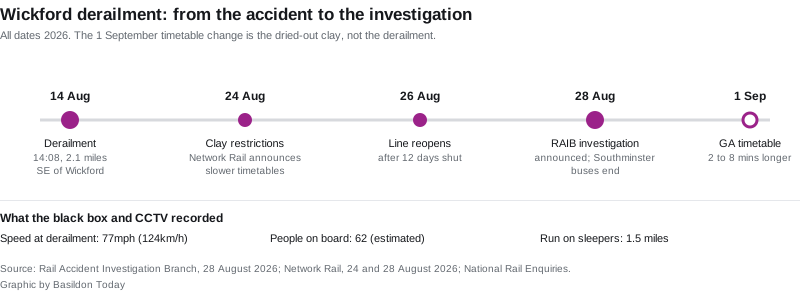
The train was travelling at around 77mph when the rear vehicle came off the rails. There were an estimated 62 people on board. The derailed wheels then ran on the sleepers and ballast for around 1.5 miles. The train stayed upright and nobody was hurt.
What the RAIB says happened
The derailment was at around 14:08 on Friday 14 August, about 2.1 miles south-east of Wickford station. The service was running from Southend Victoria to London Liverpool Street. It was a Greater Anglia train made up of two class 720 units coupled together, ten carriages in total, and it was the rearmost vehicle that derailed.
The account turns on a fault in the track itself:
- The driver reported seeing a kink in the track, which rocked the driving cab as the train passed over it.
- Forward-facing CCTV recovered from the train shows a misalignment in the track at the same spot, and that spot is the point of derailment.
- The on-train data recorder, the black box, put the speed at around 77mph (124km/h) at the moment of derailment.
- The driver was in the middle of reporting the track condition to the signaller when an emergency call came in from a train passing the other way. The driver then braked.
The train that was passing in the opposite direction picked up minor damage from flying ballast. The derailed train itself was damaged, and so were the track, the signalling and the overhead electrification equipment. That is why the line was shut for 12 days rather than a weekend.
The part that matters most locally
The RAIB has set out what its investigation will cover. One item reads directly onto the disruption the borough is living with now:
- the sequence of events leading up to and during the derailment
- the actions of those involved, and what influenced them
- the status of the track at this location and how it was maintained
- how effective any measures were to manage the risk of running trains in hot weather
- how the train performed during the derailment
- any underlying management factors
Ten days after the derailment, Network Rail announced that the clay under long stretches of the Essex railway had dried out and shrunk in the sustained heat, damaging the quality of the track, and that speed restrictions and amended timetables would follow (Network Rail, 24 August). The c2c timetable changed on 25 August. The Greater Anglia timetable between Southend Victoria and London changes on Tuesday 1 September, adding two to eight minutes to journeys from Billericay and Wickford.
Network Rail has not linked the derailment to the dried-out clay, and neither has the RAIB. What the RAIB has said is that hot-weather mitigation is one of the things it will examine. Its investigation is independent of the industry’s own and of the regulator, the Office of Rail and Road.
What the operator says
Jamie Burles, managing director of GBR Anglia, responded to the announcement the same day (Network Rail, 28 August):
“We are continuing to support the Rail Accident Investigation Branch (RAIB) following its announcement to investigate the incident at Wickford. While the line between Wickford and Shenfield has now reopened, we are very sorry for the disruption this incident caused to our passengers and our local community. We remain thankful that no one was injured.”
He added that the operator understood “the desire for answers” but that the independent investigation should be allowed to reach its conclusions, and that it would consider any recommendations made.
What it means for you
The line is open. It reopened on Wednesday 26 August, and the replacement buses between Wickford and Southminster, which were separate engineering work rather than the derailment, finished on Friday 28 August.
Three things follow from the announcement.
- Your Billericay and Wickford trains get slower on Tuesday. That is the dried-clay timetable, not the derailment. We have set out what it means from each of the five borough stations in our story on the slower timetables.
- There will be no quick answer on the cause. The RAIB publishes its findings, with any safety recommendations, only at the end of an investigation. It has not given a date.
- More restrictions are possible. Network Rail said further speed restrictions may be needed in the coming weeks and that any resulting service changes would be advised in advance.
The RAIB report, when it comes, will be published on its own website. You can subscribe there for an email when it lands.
Related
- Wickford derailment: line reopened after 12 days shut: what happened at the time, and how the closure ran.
- Basildon trains slower from 25 August as clay dries out: the timetable change, station by station.
- Basildon roadworks and travel: what is closed on the roads this week.
- Basildon train times to London: times and fares from all five borough stations.
Sources
- Rail Accident Investigation Branch, 28 August 2026 for the speed, the number of people on board, the distance run on sleepers and ballast, the kink in the track, the CCTV, the emergency call and the scope of the investigation.
- Network Rail media centre, 28 August 2026 for the GBR Anglia statement.
- Network Rail media centre, 24 August 2026 for the dried-out clay, the speed restrictions and the two timetable change dates.
- National Rail Enquiries, Wickford incident notice for the reopening on 26 August and the Southminster replacement buses to 28 August.
Have your say