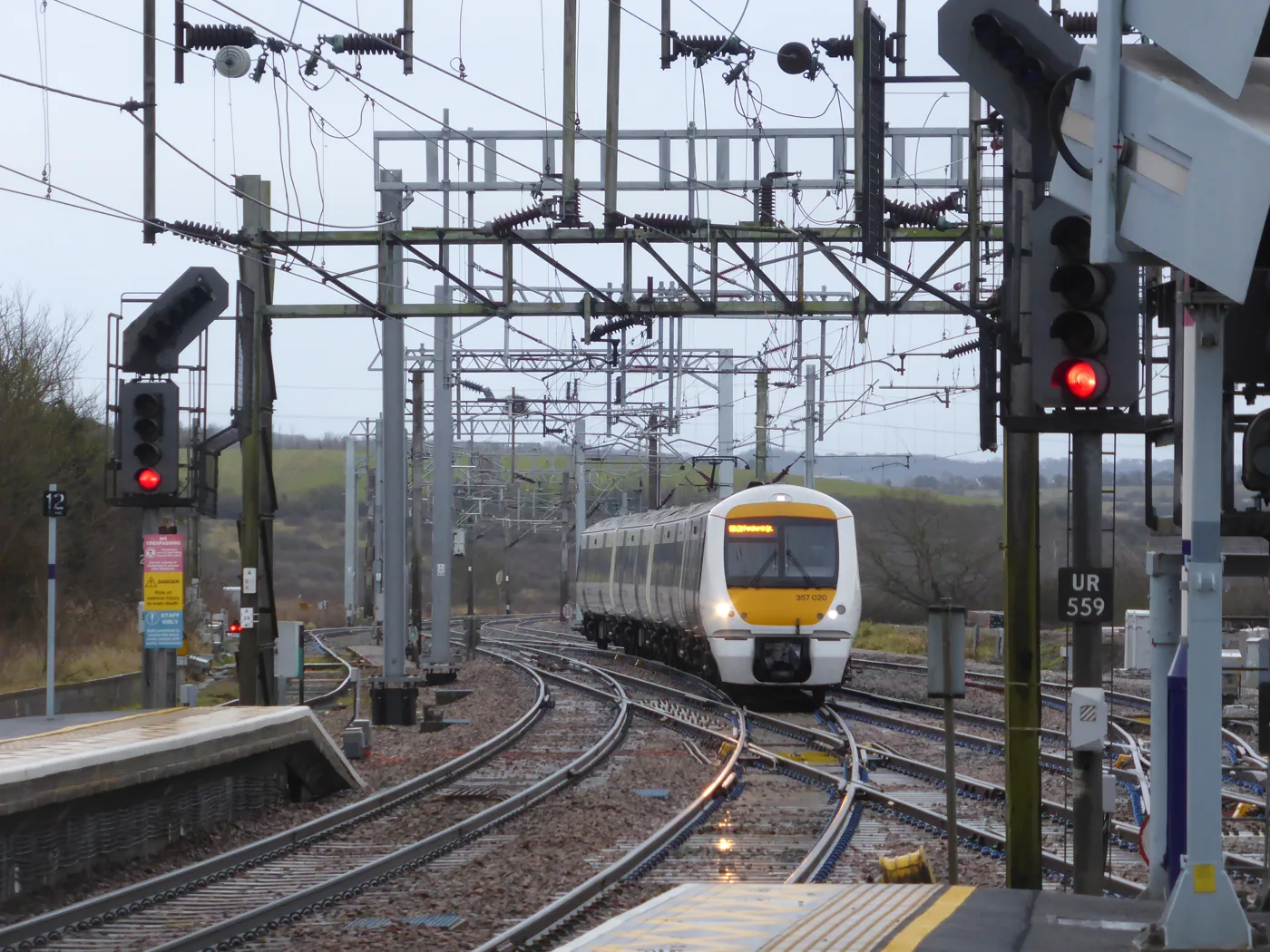

c2c journeys from Basildon, Laindon and Pitsea run up to eight minutes longer from 25 August. Billericay and Wickford follow on 1 September. Here is why.
Every train out of the borough is being slowed down, and it has nothing to do with this month’s derailment. The clay under long stretches of the Essex railway has dried out and shrunk in the heat. Network Rail says that has caused “some issues with the quality of the track”, so speed restrictions and amended timetables are being applied on both of the lines that serve Basildon borough.
The c2c timetable changed on Tuesday 25 August. That covers Basildon, Laindon and Pitsea. The Greater Anglia timetable between Southend Victoria and London changes on Tuesday 1 September, which covers Billericay and Wickford.
Some journeys take two to eight minutes longer than usual, with departure and arrival times slightly adjusted (Network Rail, 24 August).
What has actually changed
- c2c, from Tuesday 25 August. Amended timetable on the Fenchurch Street line.
- Greater Anglia, from Tuesday 1 September. Amended timetable between Southend Victoria and London.
- Journey times. Some services run two to eight minutes longer, with adjusted departure and arrival times.
- The Elizabeth line is not affected, so a change at Shenfield is not currently caught by this.
- No end date. The restrictions stay until the ground recovers.
We checked the published timetable for Thursday 27 August. The fastest Basildon departure in the morning peak, the 07:40, still reaches Fenchurch Street at 08:14. That is the same 34 minutes we recorded for our Basildon trains to London page. So the quickest train of the day has held. It is the services around it that have moved, which is exactly why Network Rail is telling people to check their own train rather than assume.
Martin Beable, Chief Operating Officer for GBR Anglia, said the amended timetables are meant to “give passengers more certainty about services and reduce the risk of short-notice disruption”, and added: “please do check before you travel, particularly if you’re used to getting the same time train every day.”
Why dry clay stops trains running normally
Essex railway sits on clay for long stretches. Clay shrinks when it dries. When the ground under the ballast moves, the track loses its level, and a track that is not level cannot safely carry trains at line speed. Network Rail’s answer is to slow the trains down where the geometry has gone, and to rebuild the foundation underneath.
The scale of that work is not small. Network Rail says engineers treated around 100km of track affected by dried-out soil across the Anglia region last year, using machines called tampers to pack the ballast back into a solid foundation. It expects to drop 49,000 tonnes of new ballast during 2026, and points to a £2.6 billion programme covering track maintenance and renewals, drainage, earthworks and monitoring.
Engineers are still monitoring the track, and the release warns that further speed restrictions may be needed in the coming weeks.
The Wickford line is open again
Separately, the Greater Anglia line through Wickford reopened this morning after 12 days shut. National Rail Enquiries updated its notice at 01:50 on Wednesday 26 August to say “Lines have now reopened and service has resumed”, with normal service between Shenfield and Southend Victoria (National Rail Enquiries).
The line had been closed since Friday 14 August, when a Greater Anglia train derailed between Wickford and Southend Victoria. Network Rail says the repairs covered 1.5 miles of infrastructure between Billericay and Hockley. Its statement on the day of the derailment said two carriages had come off the rails and remained fully upright, with no significant injuries; its 24 August release describes it as the derailment of one carriage (Network Rail, 14 August).
One thing has not gone back to normal. Buses still replace trains between Wickford and Southminster up to and including Friday 28 August. That is pre-planned engineering work, not the derailment.
The Rail Accident Investigation Branch had investigators at Wickford on the day. As at 26 August it has published nothing on the derailment. Its news feed carries no Wickford item, and the only Wickford entry in its report archive is a 2021 collision between road-rail vehicles near Ramsden Bellhouse (RAIB).
What it means for you
- Check your specific train, not the usual one. The times have moved, so the departure you have caught for years may now leave a minute or two earlier or later.
- Billericay and Wickford have a week’s grace. Your timetable does not change until Tuesday 1 September.
- Build in ten minutes if you have a connection. Two to eight minutes is enough to lose a tight change at Shenfield or at Fenchurch Street.
- Southminster passengers are on buses to Friday. Trains from Wickford resume after that.
- Do not expect this to end soon. Network Rail has given no date, only “until the ground conditions have recovered”, and says more restrictions may follow.
- Driving to the station instead? Radford Crescent opposite Billericay station is £8.50 all day and free at weekends. Our parking in Basildon page has the rest, and the current road closures are on our roadworks and travel page.
Sources
- Network Rail media centre, 24 August 2026: rail service changes in Essex and east London due to dried-out clay for the two timetable change dates, the two to eight minute figure, the cause, the quote, the ballast and tamper figures and the Wickford repair length.
- National Rail Enquiries, Wickford disruption notice, updated 01:50 on 26 August 2026 for the reopening and the Southminster replacement buses.
- Network Rail media centre, 14 August 2026 for the statement on the day of the derailment.
- Rail Accident Investigation Branch, news feed and report archive checked on 26 August 2026.
- The 27 August timetable was read from the published industry timetable through traintimes.org.uk, which republishes National Rail data.
Have your say