
Overdue high-risk fire fixes in Basildon council homes fell from 293 in June to none by September, a council report shows. Bed and breakfast use rose.
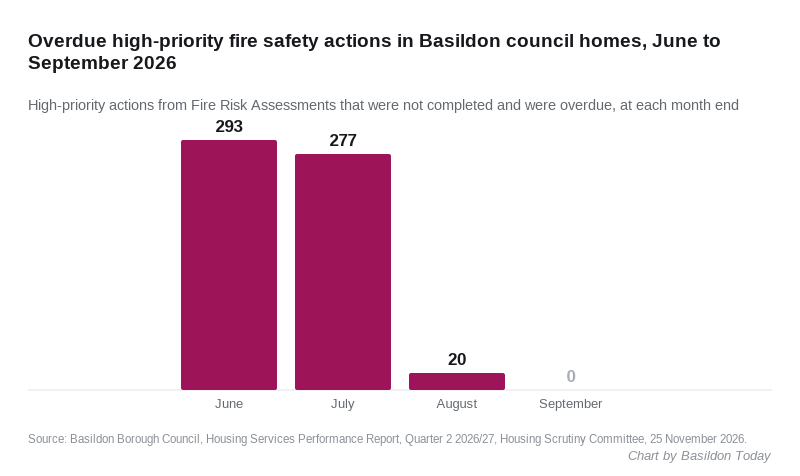
Basildon Council has cleared its backlog of overdue high-risk fire safety work in its homes. At the end of June, 293 high-priority actions from fire risk assessments were overdue. By the end of September there were none.
The figures are in the council’s housing performance report for July to September. Its Housing Scrutiny Committee will consider it on Wednesday 25 November. It is only the second report of its kind, after the first one in October showed the 293 overdue fixes.
The same report shows the pressure on temporary accommodation growing. More households were placed in bed and breakfast in September than in any month since April. Households owed the main homelessness duty have now spent more than 1,000 days in temporary accommodation on average.
Fire safety: the high-risk list is cleared
The report counts fire safety actions that are overdue, by priority, at each month end:
| Priority | June | July | August | September |
|---|---|---|---|---|
| High | 293 | 277 | 20 | 0 |
| Medium | 2,532 | 2,376 | 2,089 | 1,513 |
| Low | 76 | 56 | 48 | 528 |
Medium-priority actions fell by about 1,000 over the quarter. Low-priority actions rose from 48 to 528 in September. The report does not explain the rise.
Fire risk assessments were 100% complete in September. Asbestos checks reached 100% in August and September, up from 64.2% in May. Smoke and carbon monoxide detectors were both at 100% in August and September.
Where the council is still short
Several safety checks are below the council’s own 100% target. These were the September figures:
- Electrical inspections: 90.52% of homes up to date
- Gas safety checks: 95.96%
- Water safety checks: 49%, down from 100% in August
- Lift safety checks: 80%
The report says the water and lift dips are paperwork. The checks were done, it says, but the council does not count a home as compliant until the contractor’s certificate is on its system. It says a new system, Plentific, will automate this.
Damp and mould cases have fallen, but the oldest ones are taking longer to fix:
- Live damp and mould cases: 734 in June, down to 431 in September
- Cases past their policy or legal deadline: 632 in June, down to 321
- Average time to fix all the damp and mould in a home: 63 days in June, up to 209 days in September
Routine repairs finished within 28 days fell from 81.01% in July to 76.14% in September, against a 90% target. Satisfaction with repairs fell to 81.03% in September, below the 85% target. There were 488 disrepair claims raised by September, with 237 still live.
Complaints: more of them, answered more slowly
Stage 1 complaints jumped from 22 in June to 99 in July, then 103 in August and 102 in September. The council says this is partly a change in how it counts them. It has dropped an informal “urgent enquiry” stage, because the Housing Ombudsman’s code does not allow one.
About three in four Stage 1 complaints were answered within the Ombudsman’s timescale in Quarter 2, against a 90% target. Stage 2 replies reached 100% on time in September, after 56.3% in July. The Ombudsman opened 31 new cases about the council’s housing over the three months.
Temporary accommodation: more people, longer stays
These are the end-of-month figures from the report:
| April | June | September | |
|---|---|---|---|
| Households in temporary accommodation | 863 | 829 | 857 |
| Households placed in bed and breakfast | 39 | 31 | 45 |
| Average stay, main duty (days) | 924 | 948 | 1,034 |
| Average stay, interim duty (days) | 177 | 172 | 197 |
The report links the rise in bed and breakfast placements in August and September to bailiff evictions. It says these followed Section 8 notices served after changes to renting law took effect on 1 May 2026. One family was in bed and breakfast for longer than the six-week legal limit in September.
The council blames the long stays on a lack of homes to move people on to. Its own empty council homes are taking longer to relet: 90 days on average in September, up from 68 in June. The report also says it has no dedicated officer to find private rented homes, three temporary accommodation officers are on long-term sick leave, and it lost a lettings negotiator.
Spending on hotels, bed and breakfast and nightly lets peaked at £1,128,127 in July. It fell to £401,235 in September, inside the council’s monthly target of £479,334. The wait for a housing needs assessment fell to 67.4 days in September, from 141.3 in August.
What it means for you
- If you are a council tenant with damp or mould, the report shows most cases now open are past the council’s own deadline. Report it again if nothing has happened, and keep a note of the dates. You can complain to the council first, then to the Housing Ombudsman if you are not happy with the answer.
- If you are facing eviction, contact the council’s Housing Solutions team as soon as you get a notice. The report says the council is recruiting two prevention officers to help people earlier, before they need temporary accommodation.
- If you want to watch the meeting, the committee meets at 7pm on Wednesday 25 November. The agenda and papers are on the council’s meetings site.
The council says tenant satisfaction scores will be added from the next report, covering October to December. It has surveyed 475 tenants so far this year, through IFF Research.
Have your say