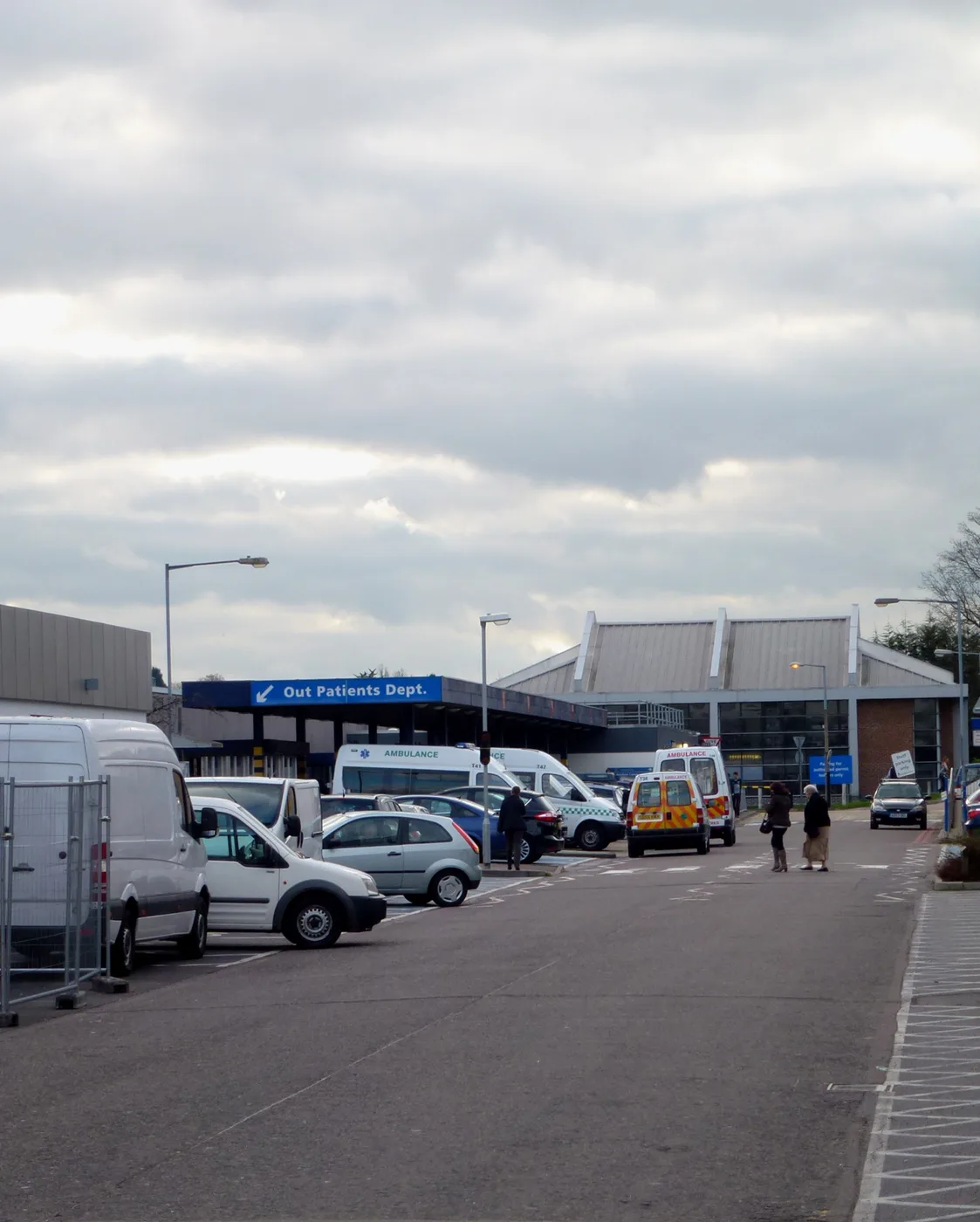

£6m will more than double Basildon Hospital's rapid assessment area from September. In July, 1,455 A&E patients there spent more than 12 hours in the department.
Basildon Hospital’s emergency department is getting £6 million, and half of it will go on more than doubling the size of the area where patients are first assessed. Mid and South Essex NHS Foundation Trust announced the investment on 19 August. Work is expected to start in September and finish by spring 2027, and the department will stay open throughout (Mid and South Essex NHS Foundation Trust).
The money splits in two:
- £3 million to expand the Rapid Assessment, Triage and Treatment area, known as RATT, from three assessment bays to eight new and larger ones
- £3 million to replace the department’s roof, which is 20 years old, with better insulation, better lighting and a more sustainable covering
The RATT area is where patients arriving by ambulance are first seen. The trust says the extra space will let doctors start tests, treatments and referrals sooner.
Maimuna Mushabe, Interim Chief Executive of Basildon Hospital, said: “We have already seen the benefits of bigger assessment facilities at Southend Hospital. Increasing our ambulance handover and assessment capacity at Basildon will help cut waiting times, improve patient flow through the Emergency Department and ensure people receive care more quickly.”
Danielle Stephenson, the department’s matron, said: “This will make a huge difference to our patients and our staff. It means we will be able to give the care we want to deliver in a place that’s fit for modern healthcare practice.”
What the figures say about Basildon’s A&E
The trust’s announcement does not carry any performance figures. NHS England publishes them, hospital site by hospital site, and they show why the department needs the space.
In July 2026, Basildon Hospital recorded 11,110 attendances at its type 1 and type 2 emergency services. Of those:
- 4,895 patients waited more than four hours, so 55.9 per cent were dealt with within four hours, against 62.2 per cent across England
- 1,455 patients spent more than 12 hours in the department, which is 13.1 per cent, against 9.6 per cent across England
That 1,455 is the highest monthly figure at Basildon since January, when it was 1,510 (NHS England, Emergency Care Data Set performance, July 2026).
Two things to keep in mind when reading those numbers. The 12-hour measure counts time spent in the department, which is not the same as the older measure of waiting from a decision to admit. On that separate measure, 1,203 patients across the whole trust waited more than 12 hours from the decision to admit to actually being admitted in July, with another 2,102 waiting between four and 12 hours. ECDS counts are also rounded to the nearest five, and July is provisional.
The Southend comparison, which is the trust’s own argument
The trust says the Basildon scheme “follows the success of a similar scheme at Southend Hospital, which opened in March”. That claim can be checked, because NHS England publishes both sites separately.
Before Southend’s expanded assessment area opened, the two hospitals looked much alike on 12-hour waits. In February 2026, Basildon was on 15.0 per cent and Southend on 13.9 per cent. Since April the two have pulled apart.
| Month | Basildon Hospital | Southend Hospital | England |
|---|---|---|---|
| October 2025 | 11.4% | 8.0% | 10.7% |
| November 2025 | 12.4% | 9.7% | 10.2% |
| December 2025 | 12.0% | 11.5% | 10.5% |
| January 2026 | 14.5% | 14.8% | 13.1% |
| February 2026 | 15.0% | 13.9% | 11.3% |
| March 2026 | 11.2% | 11.0% | 9.0% |
| April 2026 | 10.5% | 7.3% | 9.3% |
| May 2026 | 10.7% | 5.6% | 9.7% |
| June 2026 | 12.3% | 3.0% | 9.8% |
| July 2026 | 13.1% | 7.1% | 9.6% |
Two cautions on reading that chart. A single change at one hospital cannot be shown to have caused a change in its figures, and Broomfield Hospital in Chelmsford, run by the same trust and with no such scheme, was worse than both in July at 16.3 per cent. Summer months are also usually easier than winter ones, and Basildon’s July figure went the wrong way anyway.
On the four-hour measure the three sites are closer together. In July, Basildon dealt with 55.9 per cent of type 1 and 2 attendances inside four hours, Southend 58.1 per cent and Broomfield 56.1 per cent. All three were below the England figure of 62.2 per cent.
What it means for you
- Basildon’s A&E stays open through the work. If you need emergency care between September and spring, go as you would now.
- The scheme changes the part of the department where ambulance patients are first assessed. It does not add beds on wards, and ward capacity is what usually drives the longest A&E waits.
- If you are not sure whether you need A&E, NHS 111 covers Basildon and can book you a slot in an urgent treatment centre instead.
- The figures above are published every month and are worth watching. The test of this £6 million is whether Basildon’s 12-hour share moves the way Southend’s did after April, and the first month that could show it is roughly November’s data, published in December.
Basildon Hospital sits on Nethermayne, off the A176. If you are driving there, the current closures and diversions across the borough are on our Basildon roadworks and travel page.
Sources
- Mid and South Essex NHS Foundation Trust, “£6million funding announced to improve Basildon Hospital’s Emergency Department”, posted 19 August 2026 for the funding split, the bay numbers, the timetable and both quotes.
- NHS England, A&E Attendances and Emergency Admissions 2026-27 for the site-level Emergency Care Data Set performance files, published 13 August 2026, and the monthly provider figures for July 2026.
- NHS England, A&E Attendances and Emergency Admissions 2025-26 for the October 2025 to March 2026 site-level files.
Have your say